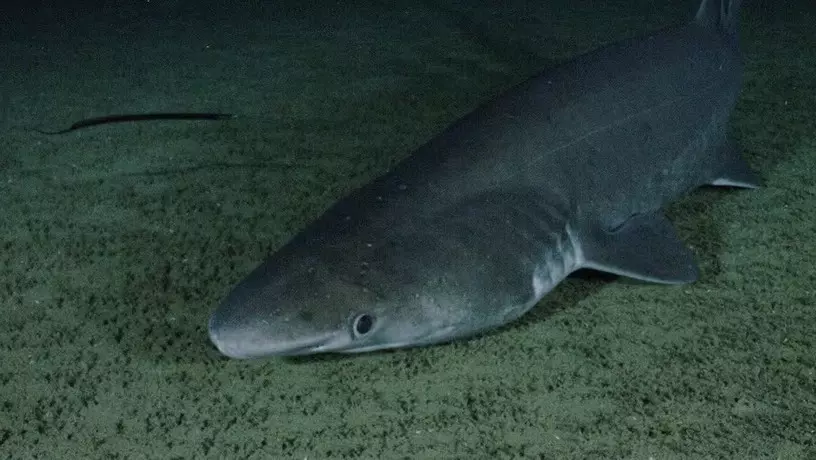
An endangered bramble shark has been recorded in UAE waters for the first time – after the sea floor-dwelling fish swam over to a submersible with researchers onboard.
The species, Echinorhinus brucus, was spotted at a depth of about 850 metres off the east coast, during an expedition led by NYUAD scientists.
Experts hailed the sighting, saying it shows how much remains to be learnt about the UAE’s marine environment.
John Burt, an associate professor of biology at NYUAD, told how the fish approached the team's submersible on the seabed about 80 kilometres from the shore.
“Almost as soon as we landed, this massive shark swam up to look at us,” said Prof Burt.
“Because it's pitch black, if there's any light down there, any organism can see it from a long distance away.
“They're curious. They popped up to see what we were doing.”
Bramble sharks are quiet creatures and live typically close to the sea floor at depths of up to 900m. This one was recorded off the edge of the continental shelf.
Harmless to humans, they are usually black or brown and can grow more than 3m long. They have two small dorsal fins at the back and thornlike denticles – toothlike structures.
In 2020, the International Union for Conservation of Nature, a global authority on the status of the natural world, classified the bramble shark as endangered, due in part to targeted and incidental catches.
Footage from the submersible shows the bramble shark moving slowly across the sea floor, with the submersible overhead.
“What's really exciting about that shark is that it has never been recorded in the UAE before,” said Prof Burt.
He said it wasn’t surprising they hadn’t been seen before, as the east coast is very shallow. However, they are present in the Arabian Sea.
“It's not just an individual,” he said. “It is a population of them that occur out there that we didn't even know existed.”
The discovery came during an expedition on the OceanX research vessel, OceanXplorer, in December. It is equipped with underwater submersible craft along with remotely operated vehicles capable of exploring depths up to 6,000 metres and acoustic mapping sonars.
Prof Burt and his team from the NYUAD Marine Biology lab were there chiefly to study a mysterious 144m-deep reef discovered about 30km off Fujairah’s coast in 2022.
The reef was first explored by Simon Nadim, a Fujairah-based technical diver. Technical divers explore deeper waters than scuba divers.
Initially, Mr Nadim thought it was a wreck. Instead, he found a remarkable formation of corals not typically encountered at that depth in these waters.
This is known as the mesophotic zone and it is thought the reef could be home to unique species.
Mr Nadim also took part in the OceanX expedition.
“We call it the twilight zone because it is very much like the sun has just set and there's just enough light there,” said Prof Burt.
Footage shows how the submersible was lowered off the OceanXplorer, before slowly descending and using its powerful lights to penetrate the darkness as the reef looms ahead.
“You can see rocks actually appearing out of the sea bottom. And on those rocks, you start to see the corals appearing,” said Prof Burt.
It covers an area of about 100m by 50m square, with a ridge of rock that rises to 4m above the sea floor, before it “slowly tapered” back down. Fish use this as a habitat for shelter and food.
“That large rocky ridge had a tonne of stuff growing on it,” said Prof Burt.
More than 80 coral specimens were collected. These included rare black corals; hard corals – the colourful ones people typically think of; and soft corals. It is believed many are new for the UAE and some are thought to be new to science and could even be endemic – found nowhere else.
“It is amazing for me as a scientist to be able to get down there and not only see it with my own eyes as the second person in the world to see this, but rather to be able to spend six hours doing detailed surveys of the site. We literally saw every coral that was on that reef.”