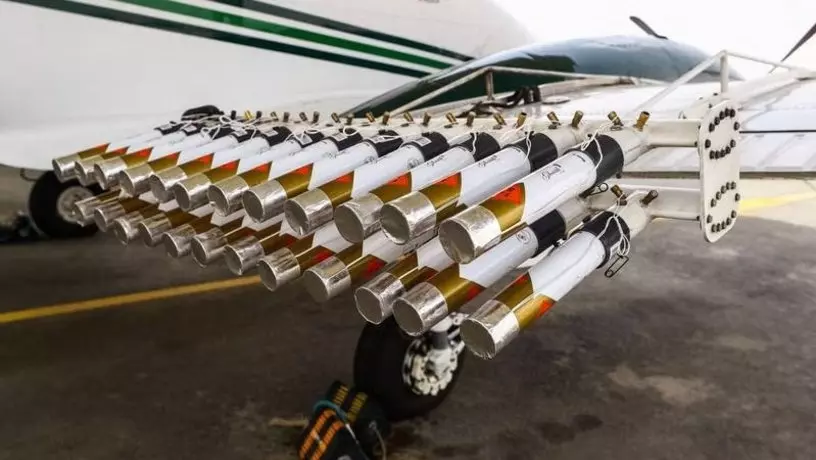
The UAE is stepping up its mission to make it rain after nearly doubling its annual number of cloud-seeding flights in the past six years.
While large parts of the country are braced for heavy downpours on Wednesday and Thursday, efforts to induce more rainfall in a largely arid climate remain crucial.
Mariam Al Mheiri, Minister of Climate Change and Environment, on Tuesday hailed the country's rain enhancement programme as key to bolstering water and food security, replenishing groundwater reserves and even driving tourism.
Ms Al Mheri spoke of the need to welcome more wet weather on the opening day of the International Rain Enhancement Forum in Abu Dhabi.
“While the immediate aim of rain enhancement is to increase rainfall, recharge groundwater, and enhanced freshwater supply, let us not forget the broader and far reaching impacts of rain on water and food security as well as tourism and weather moderation,” said Ms Al Mheiri.
“This is the underlying reason for rain enhancement to be one of the seven pillars of the UAE innovation strategy when it comes to research, continuous innovation and the complex science of weather modification.
The UAE conducted 311 cloud-seeding missions in 2022, clocking up close to 1,000 flying hours.
This is a significant increase on the 177 flights conducted in 2016.
Seeding essentially attempts to wring more rain from a cloud and involves shooting flares from planes containing materials such as salt, which attracts water, into potential clouds.
Experts from the National Centre of Meteorology have previously said seeding could enhance rainfall by about 30 per cent in a clean atmosphere or by 15 per cent in a dusty atmosphere. But it is complex and more research is needed.
Omar Al Yazeedi, Deputy Director General of the NCM, said it is hard to calculate how much rainfall their efforts are creating.
“We cannot answer that question. We need at least 20 years worth of data in order to give an accurate realistic number and results,” he said, on the sidelines of the three-day forum.
The sixth annual summit has brought together global experts to discuss advancing rain enhancement science and innovative solutions to tackle water security in arid and semi-arid regions.
Run by the NCM, seeding began in the 1990s. By the 2000s, the NCM was working with global peers such as Nasa and the National Centre for Atmospheric Research in the US.
My Yazeedi said cloud-seeding is environmentally sustainable and that the UAE was “working with nature and not against it”.
“Everything in our operation is safe and environment friendly,” he said.
He said the composition and concentration of salt particles injected into the clouds is negligible when compared to that which is found in the atmosphere.