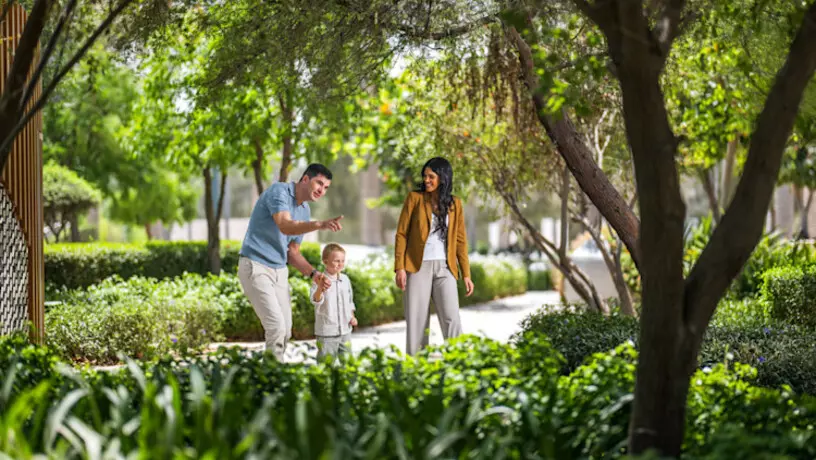
What if a forest did not need acres of land or decades to grow? That is the idea behind Dubai’s first native pocket forest, a dense mini forest at Terra, the sustainability pavilion at Expo City Dubai.
Spread across just 100 square metres, the forest contains more than 500 native trees and shrubs, creating a thriving ecosystem designed to boost biodiversity.
Unlike traditional forests, pocket forests require very little land and can be replicated in schools, residential communities, museums and other urban spaces. Also known as mini forests or micro forests, they are based on the Miyawaki Method, developed by Japanese botanist Akira Miyawaki.
Creating a pocket forest involves planting native species closely together in carefully prepared soil. The proximity between the trees and right soil conditions allow saplings to grow rapidly and after a little initial care, the trees turn into self-sustaining ecosystems.
With no chemicals and minimal maintenance, pocket forests are designed to let Nature take control. Thanks to the design, a pocket forest grows 10 times faster than normal, capturing 30 times more carbon and supporting far more biodiversity than conventional landscaping.
The first saplings at the pocket forest at Dubai Expo City were planted last year by Her Highness Sheikha Latifa bint Mohammed bin Rashid Al Maktoum, Chairperson of Dubai Culture and Arts Authority (Dubai Culture) Her Excellency Reem Al Hashimy, UAE Minister of State for International Cooperation and CEO of Expo City Dubai Authority, alongside a group of children.
The project was part of the lasting legacy of the International Council of Museums (ICOM), which was held in Dubai last year, and was developed through a collaboration between Dubai Culture and Expo City Dubai.
Planted in the Terra pavilion, the forest features native species including ghaf, sidr, samr and arak (miswak) trees, all selected for their ability to thrive in the UAE's climate.
According to Phillip Dunn, Senior Manager, Sustainability – Terra, the pocket forest is spread over just 100 square metres, with four plants per square metre, mixing tall canopy trees, shrub layer trees and ground cover sedges.
In a video posted by Dubai Expo City, he said: “They synergistically work together but they also compete for life and try and grow up really quickly, which makes them much more biodiverse and grow a lot quicker than letting a forest grow by itself."
The initiative is intended not only as an environmental project but also as a cultural one, reconnecting younger generations with native plants that have long been part of the UAE's natural landscape.
To visit the pocket forest, all you need to do is head over to Expo City Dubai and visit the Terra Pavilion.
While entry to specific exhibits at the Pavilion are paid, the Pocket Forest, which is designed as a living classroom, can be seen for free.