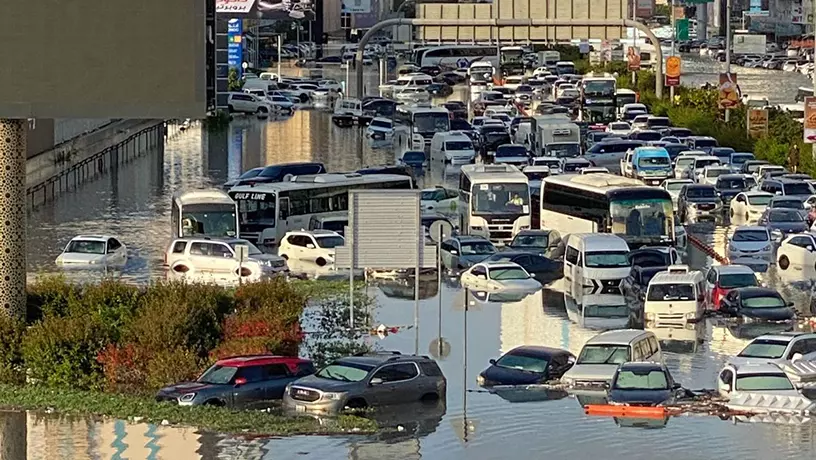
Thousands of UAE residents were forced to abandon their vehicles on roads and in parking lots after this week’s historic rainfall turned streets into rivers.
As flood waters recede, insurance experts are advising vehicle owners on the proper steps to retrieve their stranded cars.
“Owners can go retrieve their vehicles if they are in good working condition,” said Raphael Daniel, CISO/Motor Insurance Manager at Abu Dhabi-based Secure Insurance Brokers LLC.
“They can also call a recovery vehicle at the insurer’s expense if their policy allows it.”
For those unable to access their abandoned cars immediately, Daniel warned of potential repercussions. “If the vehicle is still abandoned after roads are cleared, whether intentionally or not, the government will impound it and fine the owner.”
Ashmy Arackal, Head of Claims at InsuranceMarket.ae, outlined some additional options for reclaiming abandoned vehicles covered by insurance policies. “Owners can turn to their Roadside Assistance benefit which provides free towing to an approved repairer nominated by their insurer,” she said.
Alternatively, Arackal said owners can contact police who can connect them with private recovery providers, though costs can reach AED 500 or more depending on the recovery type and distance.
She strongly advised against attempting to start vehicles submerged in water, as this can compound damage and negatively impact claims. Arackal also cautioned that towing requires shifting the vehicle into neutral mode first, which may necessitate assistance from a trained technician.
Once vehicles are recovered, the claims process begins. “All you need is a police or Saeed report to submit the claim along with the vehicle registration and driving license,” said Daniel. Insurers then assess damages either directly or by instructing owners to take the car to an approved repair workshop.
Comprehensive auto policies in the UAE cover flood damage as a natural calamity, though third-party liability plans only cover external property damage. “Insurers use repair estimates and photos from workshops to determine coverage,” explained Arackal.
“Depending on costs, they may also appoint external adjusters to further inspect the vehicle.”
As extreme rainfall events become more frequent in the UAE due to climate change, the insurance sector is being forced to re-evaluate risk modeling, underwriting, and pricing strategies.
“Many insurers are receiving a very large volume of water damage claims that are impacting loss ratios,” Arackal said. “Some have begun declining claims if vehicles were driven into flooded areas despite warnings.”
To minimise future risks, both experts advocated heeding weather alerts, avoiding driving when possible during severe storms, and never leaving cars parked in low-lying areas prone to accumulation.
While the recent flooding has created short-term challenges for UAE insurers, the well-capitalised industry is collaborating with government agencies on effective disaster preparedness and response.
“Events like flooding can have significant consequences, prompting insurers to reassess pricing and risk management,” stated Arackal. “However, UAE insurers are generally equipped to adapt to the evolving risk landscape.”
For vehicle owners impacted by the extreme rainfall, promptly following claims procedures with necessary documentation will be critical to ensuring their abandoned cars do not become permanently lost property.