One of the most technologically advanced and long-awaited attractions has opened in the United Arab Emirates. Created by the renowned Japanese art collective TeamLab, Phenomena Abu Dhabi opened its doors to visitors on April 18.
The new cultural space in the Saadiyat district unites art, science and technology in an area of 17,000 square meters. It presents original, constantly changing works of art, as well as “current installations”.
The exhibitions are different from each other - they send visitors into a world of boundless wonder and creativity. The project is intended to become a source of inspiration for a new generation of innovators, thinkers and creators both in Abu Dhabi and beyond.
The unique architecture of the space was designed by the teamLab studio, and its implementation was carried out by the architectural firm MZ Architects from Abu Dhabi. Ticket prices start from 150 dirhams.
Among the many other exhibits:
Massless and Dark Suns: Spheres of light and darkness collide, challenging our perception of reality. The luminous spheres seem material, but they cannot be touched - they exist only in the perception of the observer. Violet-blue spheres of darkness also appear, behind which a bright glow flashes, creating harmonious waves that are transmitted to neighboring spheres.
Levitating Void: Continuing the theme of light and darkness, this exhibit demonstrates the energy concentrated in the void. This void is created and supported by the environment. It can be moved or even dropped, but as if by instinct, it rises again and hangs in the air.
Living Crystallized Light: This work does not exist separately - it is shaped by a unique environment. Ordinary substances such as air, water and light become phenomena from which art itself is born.
Autonomous Abstraction: each point of light flickers and changes color in its own rhythm. When someone touches them, the rhythm changes and becomes random, but the nearby points return to a spontaneous order.
Wind Form: The air flow changes under the influence of the shape of the space and the presence of people. Particles interact with each other, creating lines that display their trajectories.
Floating Lamps: Each lamp floating on the water glows in its own rhythm. Over time, they begin to influence each other, and their flickering synchronizes. When visitors touch the lamps, their rhythm changes again.
Tea in Spontaneous Order: When a cup of tea is brewed, it begins to glow and make a sound in its own rhythm. Art appears at the moment of brewing tea and disappears when the tea is drunk.
Continuous Trajectories in Flow and Form: The space is filled with continuous trajectories that create a three-dimensional form. These lines are constantly changing, transforming the form of existence.
Circulating Universe of Water: the flow of water reacts to the shape of the room and the movements of people, constantly interacting with other flows. This is an endless interaction of particles, the trajectories of which form lines.
Fluttering butterflies: butterflies appear on the walls and floor, where people touch them. Despite the apparent chaos, their movements are still subject to internal order.
Biocosmos: the movement of hundreds of thousands of birds looks like a single living organism. Even elements separated by time and space, in the presence of order, are perceived as a single whole.
Spontaneous order in chaos: color strokes have no single center and move without external control. Through simple interactions, spontaneous order arises even in chaos.
Changing continuum: even if the elements are separated in space and time, the appearance of a structure unites them into a single whole. Despite external changes, the essence remains. This is a living organism - biocosmos.
Massless amorphous sculpture: the only materials here are soap, water and air. A huge sculpture is formed from soap bubbles, ignoring the very concept of mass.
Accumulation of Time: the water level in the exhibition changes, transforming the "landscape". At some point, the bodies of people and the work itself merge into a single whole, creating a sense of continuous perception between us and the world.
Waterfall of Light Particles: this series is inspired by a waterfall in the mountains of Shikoku. Light particles cascade down, leaving traces from which a waterfall of light is born.
Megaliths in the Garden of Roots: these megaliths are connected to each other, despite being scattered around the world. The roots of the trees stretch through the floors, into a space where they can even grow in the air.
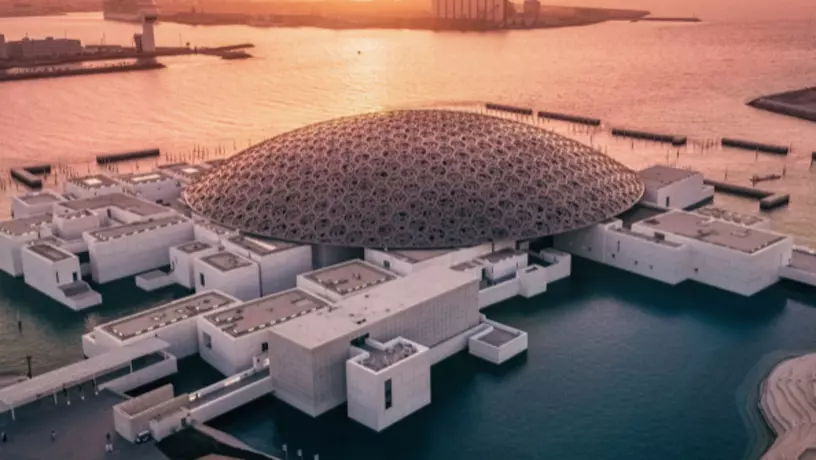
The construction of the cultural quarter on Saadiyat Island in Abu Dhabi is planned for completion by 2025. Two large-scale cultural facilities will appear on the island - a branch of the Guggenheim Museum and the Zayed National Museum, as well as the Abu Dhabi Museum of Natural History. The island is already home to the Louvre Abu Dhabi, the Manarat Al Saadiyat gallery and the Berklee Conservatory of Music Abu Dhabi.