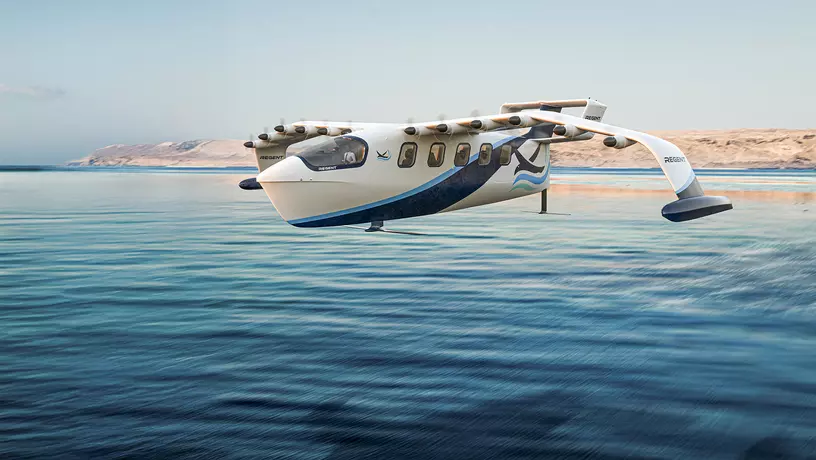
Electric seaglider developer Regent expects its plans to manufacture the flying ferry in the UAE to create more than 1,000 high-tech jobs in Abu Dhabi over the next decade, providing new opportunities and training for Emiratis. The use of seagliders is set to slash travel times from Abu Dhabi to Dubai by half.
The Rhode Island-based start-up's joint venture with Abu Dhabi's Strategic Development Fund (SDF), an investment company wholly owned by defence and technology conglomerate Edge Group, will hire for roles in engineering, advanced manufacturing, maintenance, training and support crew, told Billy Thalheimer, co-founder and chief executive of Regent.
“Bringing these jobs not only means we're employing people today, but it means we're setting up a full training pipeline and we're engaging with local universities. There's really going to be a local focus to this,” Mr Thalheimer said.
“In order for this to be sustainable … we do need to train and leverage that local footprint, so there's also a significant portion of Emiratisation built into the recruiting and training plan … We're talking about less than a half.”
The capital size of the project is a “minimum” of $250 million over the next 10 years, which both Regent and SDF will contribute to, Mr Thalheimer said.
“It's going to be a combination of equity and debt that will cover head count, research and development, the [production] facility and the build of the vehicles themselves. The $250 million is an all-in number, so it's a really significant project,” he said.
The initial investment of $250 million may increase amid plans to expand the project after establishing a base for high-tech and electrification manufacturing and maintenance that can meet commercial demand in the Middle East, Europe and Asia-Pacific.
“We've said that when we're successful, not if we're successful, how do we make this even bigger? How do we add more facilities? How do we make this centre of excellence really scale across the entire Eastern hemisphere?” Mr Thalheimer said. “About 40 per cent of the world's population lives in coastal communities, so we have this incredible backlog of $9 billion and the majority of commercial demand is in the Eastern hemisphere, which this joint venture would target to serve.”