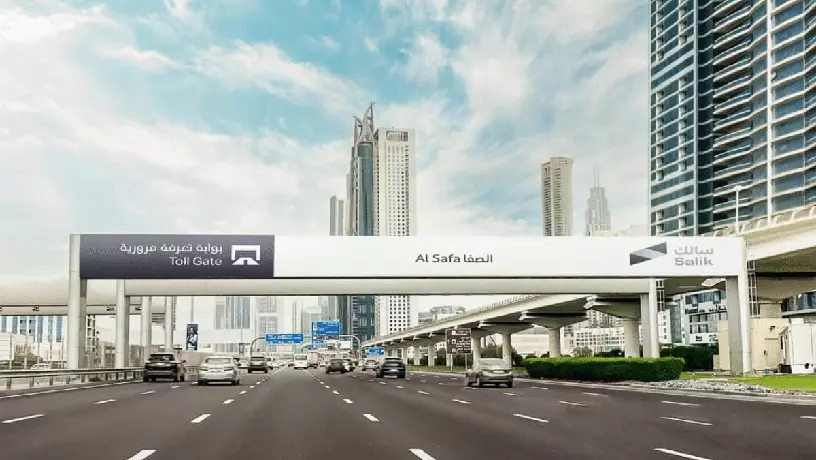
Changes to Abu Dhabi's road toll system come into effect on Monday.
Charges are to be extended for an additional two hours each day under revised transport rules from September 1.
The Integrated Transport Centre said drivers will pay Dh4 for travelling through the emirate's Darb toll gates from 3pm until 7pm from Monday to Saturday, an extension of the current charging period of 5pm to 7pm.
Charges on the morning commute – in place from 7am until 9am on Monday to Saturday – will remain unchanged, transport authorities confirmed.
Abu Dhabi's network of road toll gates remains free to pass through outside of the set morning and afternoon hours.
Charges are also waived on Sundays and on official public holidays.
The four toll gates are positioned at key entrance points to the city. They are located on Sheikh Khalifa Bridge, Sheikh Zayed Bridge, Al Maqta Bridge and Musaffah Bridge.
The ITC, which is part of the Department of Municipalities and Transport, said the move is part of efforts to boost traffic flow in peak hours.
The flat Dh4 fee for passing toll gates in the peak morning and afternoon hours is unaffected by the new regulations.
The revised measures will also remove daily and monthly caps for road toll usage.
Currently, there is a Dh16 limit on road toll charges that can be collected daily, meaning motorists could pass through charging points an unlimited number of times without having to pay more than that fee.
Monthly limits were set at Dh200 for the first vehicle registered, Dh150 for a second vehicle and Dh100 for a third.
The existing exemption policy on fees will continue for eligible groups, including people with disabilities, low-income families, senior citizens and retirees.
Q Mobility, a subsidiary of Abu Dhabi Holding Company (ADQ), oversees the management and operation of the Darb system and will work with authorities to implement the updates.
Abu Dhabi's road toll system came into force in January 2021. It was introduced as part of government efforts to reduce congestion and encourage people to use public transport.
The capital's population has grown steadily in the years since its launch, putting pressure on its road network as the number of cars registered increases.
Abu Dhabi's population has crossed four million for the first time after a 7.5 per cent surge in 2024
The emirate's population stood at 4,135,985 by the end of last year, spurred by a 9.1 per cent increase in its workforce, official figures released in June show.
Abu Dhabi's continuing population boom comes as the emirate cements its status as a leading destination for businesses and investors, while new residential and leisure developments take shape.
Abu Dhabi's population has increased by 51 per cent in the past decade, rising from 2.7 million in 2014 to more than 4.1 million, data from the Statistics Centre in Abu Dhabi shows.